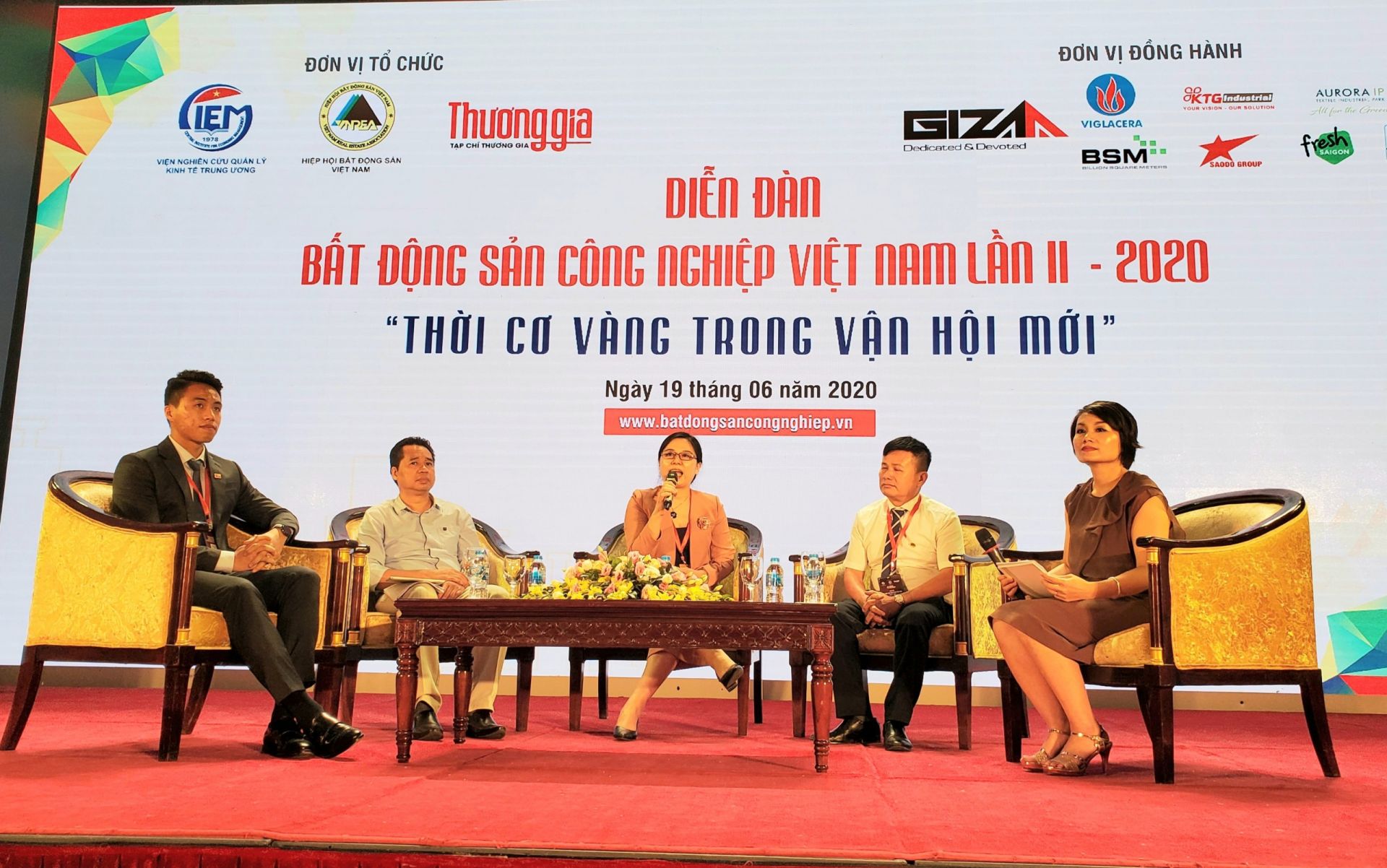
TGO - Friday, June 19, 2020 | 08:56
Following the success of the first event - held in 2019, VIETNAM INDUSTRIAL REAL ESTATE FORUM 2020 this year continues to be held to become an opportunity to share, exchange and connect businesses operating in the fields of production - business and real estate as well as an opportunity to listen to industry experts discuss and discuss new trends of the market. industrial real estate market, especially after Vietnam has basically successfully controlled the Covid-19 epidemic.
Attending the forum were representatives of ministries and branches, representatives of provinces and cities, representatives of the Vietnam Real Estate Association, representatives of associations, provincial associations, domestic and foreign businesses, and press and media units.

8:45 am: Forum officially begins
In his opening speech, Mr. Nguyen Manh Ha - Vice Chairman of the Vietnam Real Estate Association said that the Vietnamese real estate market has entered the adjustment period, the industrial real estate segment has emerged as a bright spot, creating strong confidence in growth in the eyes of international investors. Both in the short, medium and long term, this will become a segment with good growth momentum, especially when the economy has the prospect of recovering after the Covid-19 pandemic; The investment and business environment has improved, Vietnam is a safe destination in the world; Many free trade agreements officially take effect...

Mr. Ha assessed that in recent years, Vietnam's real estate market has developed rapidly in both scale, contributing to economic growth and the level of spread to other industries and occupations, with a rapid increase in quantity, product structure, investment capital sources and market participants.
'The positive results of Vietnam's real estate market can be seen from results such as: The real estate sector contributed 0.4 percentage points in economic growth; Total revenue related to real estate accounts for about 11% of total budget revenue, equivalent to nearly 3% of GDP; The development of the real estate market has also led to the growth of a series of markets in capital, construction, production of construction materials, furniture, and labor (world experience shows that for every investment in developing 1 square meter of housing, 17-25 workers are needed); Investing 1 USD in real estate will attract an additional 1.5 - 2 USD of social capital participation (rate of about 200%); Tourism real estate is increasingly asserting its important role in the national tourism development strategy," Mr. Ha affirmed.
However, Vietnam's real estate market still has many difficulties. For example, after a period of continuous growth (from 2014 - 2019), the real estate market tends to stagnate in some segments; Financial resources for investment in real estate projects are not yet diverse and sustainable, mainly still depending on bank credit capital and customer advances; Currently, construction investment activities are governed by about 12 different Laws and hundreds of Decrees and Resolutions of the Government, the Prime Minister, and guiding Circulars of ministries and branches.
In addition, there are nearly 20,000 standards, regulations, and economic-technical norms, from determining investment policies, capital needs, preparing for investment, implementing construction investment and completing construction investment to put the project into operation. Many legal regulations on investment, construction, business, and operation of real estate still have many overlaps, contradictions, and inadequacies.
In addition, this market still lacks legal regulations in regulating new real estate products appearing on the market such as tourist real estate (tourist villas, tourist apartments, tourist townhouses); Negative impacts of the Covid-19 pandemic: Disrupting and disrupting the activities of real estate businesses, especially marketing, product promotion and sales; Cash flow was seriously affected because all sales and purchasing activities were stopped due to the implementation of Government measures on movement restrictions, social isolation, and due to people's defensive mentality in the context of the Covid-19 epidemic; The real estate market has had a double impact due to having to cope with many difficulties in the past 2 years and the pandemic, so real estate corporations and businesses need to make efforts to endure and overcome this extremely difficult period.
According to Mr. Ha, in 2019, Vietnam has been continuously developing, gradually becoming one of the destinations attracting investment in manufacturing industry in Southeast Asia. The strong growth of the market is thanks to Vietnam's orientation in building an export-focused economy; Promotion of the establishment of key industrial and economic zones; Active participation in Free Trade Agreements (FTA); strong economic growth in recent years and the possession of a young, abundant, low-cost workforce.
The evidence is that in 2019 and the first half of 2020, despite the general difficulties of the market and the complicated developments of the international situation, Vietnam's industrial real estate market has had strong developments.
According to a report from the Department of Economic Zone Management (Ministry of Planning and Investment), as of the end of March 2020, the whole country had 335 industrial parks established, of which 260 industrial parks were in operation and 75 were under construction.
In the above context, along with resort real estate with potential for recovery and growth in the medium and long term, the industrial real estate market emerges as the most attractive segment in the coming period.
From the above analysis, Mr. Ha believes that it is possible to imagine the initial steps and turning in a more positive direction of the industrial real estate market. However, in order to develop quickly and sustainably, especially in anticipation of attracting "clean" and quality FDI capital flows in the new context, when shifting supply chains and shifting production is becoming more and more clear, it is necessary to aim at solving some of the following issues: improving the investment and business environment; Localities need to accelerate and complete fundamental infrastructure by attracting private resources and speeding up the disbursement of public investment capital in key projects; Promote restructuring of existing industrial parks and development of new industrial parks associated with housing and public works planning to serve the lives of workers; Review planning and prioritize industrial real estate development in qualified key economic regions.
In the introduction to the forum, Ms. Tran Thi Hong Minh, Director of the Central Institute for Economic Management Research - CIEM said that, up to this point, even though many countries have publicly discussed plans to reopen the economy, the development of the Covid-19 epidemic at the global level is still quite tense. Even discussion of a second wave of the epidemic is becoming more common. These developments have had a significant impact on the regional and global value chain, thereby affecting the process of shifting foreign direct investment.
The world economic context today and after the COVID-19 pandemic is quite uncertain. Foreign investors will be more cautious in deciding on investment locations and/or express more clearly their desire to diversify investment locations. The fact that our country has made early changes in repelling the COVID-19 pandemic can be viewed positively by foreign investors, not only in terms of timing but also in the Government's operating capacity. If we continue to maintain these changes, along with promptly building and gradually moving to implement a post-COVID-19 economic recovery plan, we will have a significant opportunity to attract quality foreign investment.
"An important requirement is that we must improve infrastructure to serve the investment, production and business activities of enterprises. In particular, the development of industrial park infrastructure is particularly important. That importance does not only come from the needs of investors who are present or wish to invest in Vietnam."
Ms. Tran Thi Hong Minh
According to Ms. Minh, over the past 30 years, developing industrial park and economic zone infrastructure has been one of the breakthroughs in the process of building and upgrading the socio-economic infrastructure system and developing industrial production. Investors trading in industrial park infrastructure, developing functional areas in economic zones mobilize capital to build infrastructure in these zones to synchronously connect with other functional areas in economic zones, with infrastructure outside the industrial park fence.
With available infrastructure, industrial parks and economic zones create favorable conditions for secondary investors to implement projects, while also making an important contribution to improving the infrastructure system, including rural infrastructure of localities, contributing to the economic restructuring of the locality and the whole country. On the contrary, some foreign-invested enterprises, after doing business and accumulating effectively in Vietnam, have considered, supported, and even directly participated more in reinvesting in industrial park and economic zone infrastructure.
"The COVID-19 pandemic does not change the above requirements. Instead, the golden opportunity from attracting foreign direct investment requires us to take faster, focused, and more effective actions."
Ms. Tran Thi Hong Minh
According to her opinion, Ms. Minh believes that industrial real estate development must contribute more directly and strongly to green growth, reduce emissions, and be associated with promoting corporate responsibility. The COVID-19 pandemic has also increased discussions about the need to develop a circular economy. "In my opinion, there is no place more favorable than an industrial park in testing circular economic development," Ms. Minh affirmed.

In addition, industrial real estate investment must also help create motivation for industrial parks in our country to substantially improve issues related to workers (not simply creating jobs but also becoming a place to create "social security" for them while also significantly improving links between businesses, especially between domestic and foreign businesses.
The effectiveness of industrial parks is not only evaluated by occupancy rate, enterprise size, export scale, contribution to the state budget, etc., but also needs to be seen from the perspective of links between zones, to take advantage of local advantages. Developing industrial zones will be difficult to be effective from a regional and national perspective if zones in neighboring localities mechanically imitate each other.
It is here that each locality and each industrial park must "overcome the fear of being different from others". From a policy perspective, priority is not only towards developing infrastructure within industrial parks, but also connecting infrastructure between industrial parks. By doing that, industrial parks will directly contribute to improving links between localities in the region - a requirement that we have recognized for many years but have not yet effectively realized.
According to the assessment of Mr. Tran Quoc Trung - Deputy Director - Economic Zones Management Department of the Ministry of Planning and Investment, by the end of May 2020, the whole country had 561 industrial parks including industrial parks in the general planning for construction of economic zones included in the approved planning with a total area of about 201 thousand hectares (accounting for 0.6% of the total land area of the country). These include: 374 established industrial parks with an area of about 114.4 thousand hectares (accounting for 56.9% of the total planned area) and 259 unestablished industrial parks with an area of about 86.6 thousand hectares (including 55.8 thousand hectares of 187 industrial parks in the planning but the entire area has not been established and 30.8 thousand hectares of 72 partially established industrial parks).

Regarding the orientation of industrial park development, Mr. Trung said that it is necessary to develop the quantity and scale of industrial parks to ensure sustainability, comply with the principle of promoting local strengths, creating conditions for economic development of regions and industry clusters; not spread evenly according to administrative boundaries.
In addition, a core industrial park system must be formed with a leading role in the development of national industries. In addition, developing a system of small and medium-sized industrial parks creates conditions for industrial development in rural and mountainous areas, moving towards balance in industrial park development to reduce pressure on traffic, urban areas, environment and social infrastructure; narrow the gap in socio-economic development; ensure effective land use; Limit the development of industrial parks on agricultural land with stable productivity.
In particular, we must promote the development of industrial parks in depth, improve quality and operational efficiency; Restructuring projects in industrial parks through technological innovation, improving added value and being environmentally friendly; Diversify investment cooperation methods to develop industrial park infrastructure; Encourage the mobilization of private resources in the construction and development of industrial parks.
Mr. Tran Quoc Trung
To do this, Mr. Trung believes that it is necessary to complete the legal corridor for industrial park development, strengthen management and innovation, improve the efficiency of industrial park planning, innovate the current industrial park model (multi-industry) and develop a number of new industrial park models in an ecological direction with higher efficiency (eco-industrial parks, supporting industrial parks, industry-linked industrial parks, industrial parks - urban areas - services and consolidate and improve the efficiency of the management apparatus. State Industrial Park
As well as investing in synchronous construction of industrial park infrastructure associated with social infrastructure to ensure the operation of industrial parks; perfect institutions and policies and strengthen inspection and supervision of industrial park environmental protection, perfect institutions and policies to improve investment attraction efficiency, strengthen cooperation in developing industrial parks and improve the effectiveness of investment promotion in industrial parks.
Mr. Pham Minh Phuong - Chairman of the Club of Management Board of Industrial Parks and Economic Zones; The head of the management board of Hai Duong province's industrial parkssaid that Vietnamese industrial real estate is in the period of "clearing the nest to welcome the eagle". Therefore, this is an opportunity for Vietnam to prepare well to become a bright spot attracting many investment capital flows.

In recent times, Vietnam's industrial real estate has been highly appreciated because it has signed many trade agreements such as CPTPP and EVFTA, but currently the scale of many industrial parks is still small, to attract large businesses along with supporting businesses, we need to have a clean land fund.
To solve this problem, it is necessary to pay attention to policies. Investors must choose businesses with enough financial capacity to solve the problem of site clearance so that they can take full advantage of the opportunities we are about to receive.
Mr. Pham Minh Phuong
In reality, making industrial real estate is different from residential real estate because you have to spend a large amount of capital to invest in infrastructure and production zones, but the capital recovery is trickle-down, and there is pressure on the occupancy rate.
Mr. Nguyen The Chinh - Director of Real Estate Department of Viglacera Corporation - JSCrecommends the need to consider shortening the time to select industrial park investors, currently about 2 years, many opportunities will be lost. Enterprises investing in infrastructure need local support in site clearance, this is the key decision point that determines the progress of infrastructure construction.

In addition, industrial park investors should be assigned to create housing areas for workers without having to bid. Currently, there is Decree 100 on the management and construction of social housing, while housing for workers still has 3 subjects: industrial park investors, businesses in industrial parks or businesses with real estate business functions.
Mr. Nguyen The Chinh
In fact, the issue of housing for workers is very important so that they can settle down, ensure social security so they can work with peace of mind, and if industrial park investors build housing for workers, the price will be much cheaper. We currently have 12 industrial parks, 9 of which have housing for workers.

10:10': Discussion session 1: New generation industrial park - An indispensable model for Vietnamese industrial real estate
Participating in the discussion session were Ms. Le Thanh Thao, National Representative of the United Nations Industrial Development Organization - UNIDO in Vietnam; Dr. Nguyen Cao Lanh - Dean of the Faculty of Architecture and Planning of the University of Civil Engineering, Mr. Pham Hong Diep, Chairman of Shinec Joint Stock Company, Mr. Dang Trong Duc - Deputy General Director of Khai Toan Group (KTG).

Ms. Le Thanh Thao: The benefits of eco-industrial parks are summarized in 3 main aspects: economy, environment, society.
When talking about ecological factors, we often talk about the environment. First, the economic benefit is completely higher than the initial investment, investors are most interested in the economic aspect. Investing in ecological solutions helps reduce waste into the environment. Ecological development creates a better environment for workers, increases productivity, creates new jobs and new services. Developing eco-industrial parks helps improve the investor's image towards businesses located there, improving relationships with the community.
Mr. Pham Hong Diep - Chairman of Shinec Joint Stock Company: Vietnam can create a model of 5 eco-industrial parks like the world is doing. Nam Cau Kien Industrial Park, owned by SHINEC Joint Stock Company, was born as a green, environmentally friendly industrial park, in harmony with the rural safety network by following state standards, providing standard services from telecommunications to wastewater treatment, fire prevention, incident handling, housing systems for employees...
This eco-industrial park will serve as a local economic, cultural and social center. There will be businesses specializing in wastewater treatment, industrial waste collection, food supply, a system of food markets, cheap supermarkets, flower gardens, parks, entertainment areas... When investors choose Nam Cau Kien, they will benefit greatly because there is already a symbiotic relationship in this industrial park.
Dr. Nguyen Cao Lanh - Head of the Faculty of Architecture and Planning of the University of Civil Engineering:For new generation industrial parks to develop, they must become organic entities, organically interacting with each other and interacting with the urban area.
The reason for choosing the phrase new generation industrial park is that Vietnam is on the path of industrialization, and the nucleus of industrialization is industrial parks. According to the Government's Resolution, by 2030 we will become a modern industrial country. We only have 10 years left to complete this very new goal. With the model of the old industrial park, we are very concerned about being able to achieve that goal. On the real estate front, Vietnamese real estate businesses have full potential, this is an inevitable opportunity and requirement for a new generation of industrial parks.
Mr. Pham Hong Diep - Chairman of Shinec Joint Stock Company: The planning for converting from a normal industrial park to an eco-industrial park as the Prime Minister mentioned is a circular economic zone. Mr. Diep affirmed that all Shinec employees will be ready to contribute to UNIDO so that the country can develop more and more.
Mr. Dang Trong Duc - Deputy General Director of Khai Toan Group (KTG):Investment in industrial parks depends on the size of the industrial park. For small businesses, sometimes they are not ready, because they do not have a complete human resources apparatus. KTG stands in the middle to solve those difficulties. Regarding the time to complete a ready-built factory, when a business contacts KTG it usually takes 2 months, while larger businesses need an arrangement time of maybe 6 months.
I fully support the idea of an eco-industrial park. We have surveyed many industrial parks and we highly appreciate the ecological criteria. From an investment perspective, we also have a clear bond with businesses because when we meet the green finance issue, we will not increase prices without reason, so we will also promote more ecological industrial parks to attract more businesses.
10:45': Discussion session 2 - Being proactive about the "golden opportunity" to attract FDI capital
Participating in the discussion session was Professor. Dang Hung Vo - Former Deputy Minister of Natural Resources and Environment; Mr. Do Nhat Hoang, Director of the Foreign Investment Department - Ministry of Planning and Investment; Mr. Vu Tu Thanh - Deputy Director of Asean, Head of Vietnam Representative of the US-Asean Business Council; Mr. Duong Nguyen Thanh - Vice Chairman of BSM Holdings Company.

Mr. Do Nhat Hoang - Director of the Foreign Investment Department - Ministry of Planning and Investment:Transformation and restructuring are necessary. To seize this golden opportunity in attracting investment, it is necessary to absorb this capital flow. Resolution 50 of the Prime Minister has set a goal in attracting FDI which is to attract selective investment. According to that orientation, Vietnam needs to attract projects with quality and spillover value, aiming at national development such as high technology, technology transfer and added value of foreign investment in Vietnam. The National Assembly passed the investment law, with provisions on incentives and human resource training.
Mr. Vu Tu Thanh - Deputy Director of Asean, Chief Representative of Vietnam US-Asean Business Council:Vietnam needs to announce its decision to establish a working group to attract the wave of businesses diversifying their supply chains out of China. Foreign investors looking at the ASEAN region will see that Vietnam is a member economy contributing to the development of ASEAN. No single economy in ASEAN can hope to replace China but must join together.
In ASEAN, it is necessary to achieve coordination in policies. However, because there is still mutual competition, it is difficult to compete with China. For Vietnam, if localities are not connected, large-scale investors will not receive synchronization in production and business processes, causing increased costs...
KTG business model - linking industrial parks together, welcoming investors, increasing the attractiveness of Vietnam's industrial park system compared to the region. When foreign investors enter Vietnam, there are many factors that affect their decisions: Investors are interested in industrial parks, need a database of industrial parks and need an industrial park ranking system (not yet available in Vietnam). Looking further, not only connecting with large enterprises but also small and medium enterprises, will be within the reach of Vietnamese businesses.
Mr. Vu Tu Thanh
Professor. Dang Hung Vo - Former Deputy Minister of Natural Resources and Environment:I think that FDI opportunities appeared before Covid-19, but "thanks" to this pandemic, this trend has become stronger. Therefore, we must ask the question "What to do to seize this opportunity"?
Currently, the quality of industrial park management in Vietnam is still very limited, it can even be said to be "subsidized". Administrative procedures for managing industrial parks are still burdensome as there are too many procedures. We must understand that we strictly control to promote development, but it seems that the more tightly controlled by the State, the more "shrunk" the development of industrial parks becomes. We need planning, we need to change, otherwise our thinking will be distorted when foreign investors enter Vietnam.
We must further open the industrial real estate market. Is our legal system ready to welcome the "eagle"? I think not yet.
The world has moved to the concept of Eco-Industrial Park. Many people understand ecology as ensuring green, clean elements of the environment and sustainability in development. But the reality is that an ecological industrial park means that the industrial park is approached in a way that builds an ecosystem, with a symbiotic relationship with each other, thereby creating a sustainable relationship.
Mr. Duong Nguyen Thanh - Vice President of BSM Company: Vietnam has a problem, which is that the local labor force (labor source, quality of skilled labor) is lacking. In addition to the interaction and connection between industrial investors who need vocational schools, local governments should create conditions to improve formal skills.
During the investment process, attracting investment, local government agencies are expected to support and participate in site clearance. Need support in interactions between schools - localities - businesses to train middle-level management and skilled human resources.
Mr. Do Nhat Hoang - Director of the Foreign Investment Department - Ministry of Planning and Investment:To enhance the quality of FDI capital flows, what we need to pay attention to is the ability to absorb this capital flow. Therefore, in the coming time, we need to promote restructuring to diversify.
And Vietnam will need to provide available land, but it must be suitable and meet the wishes of investors. Besides, it is necessary to find available skilled human resources or gather skilled labor resources from abroad and establish an ecosystem (worker housing, cultural areas, logistics...).
11:30': Discussion session 3: Solutions to develop housing for workers in industrial parks?

The discussion session was attended by Mr. Ha Quang Hung, Deputy Director of the Department of Housing Management and Real Estate Market; Mr. Nguyen Manh Ha - Vice Chairman of Vietnam Real Estate Association; Dr. Le Xuan Nghia, Economic Expert - Member of the National Monetary and Financial Policy Advisory Council; Mr. Do Duc Dat, Chairman of the Board of Directors of Thu Do Investment and Trading Joint Stock Company.
Mr. Do Duc Dat, Chairman of the Board of Directors of Thu Do Investment and Trading Joint Stock Company: Worker housing is one of the social housing models. Although social housing is developing well, the rate of worker housing being built for industrial parks is still very low, and there will certainly be a large shortage in the future.
In my opinion, it is very difficult to build workers' houses because of two problems: customers - workers, their purchasing power and rental power are very low as well as their living habits are different, they do not have long-term attachment to the industrial park, so the buying demand is low, the rental demand is very demanding.
Second is competitors. Currently we have 3 models: state investment - industrial park investment - investors invest in worker housing. If the policies are unfair, the weak position will fall on workers' housing investors, who, although they really want to invest, face many difficulties. If there is no fair connection and sharing so that workers can see the benefits of worker housing, it will be very difficult for them to decide to stick with worker housing.
Mr. Ha Quang Hung, Deputy Director of the Department of Housing and Real Estate Market Management:Regarding the policy system for social housing and worker housing, there is currently complete legal action such as the Housing Law and Decree 100. But the results of social housing including worker housing are not as expected.
Currently, the whole country reaches 42%, developing 5.2 million m2 of housing. Housing for workers is 28% completed compared to the need of 8.3 million m2. The results are not high because of the following points:
First, in the provisions of the Housing Law and Decree 100, there are regulations on setting aside land funds to develop social housing and housing for workers. Regulations on infrastructure construction must set aside land funds to build social housing, but not many localities have implemented it.
Second, the capital bottleneck is that people with low incomes and customers are not allowed to participate in loans.
The government's capital resources for social housing development are very small. The Government has just assigned the Ministry of Planning and Investment to consider providing an additional VND 1,000 billion to the Policy Bank and VND 2,000 billion to compensate for interest rates for investors to develop social housing and housing for workers.
Mr. Ha Quang Hung
Dr. Le Xuan Nghia, Economic Expert: I think that with 1,000 billion VND for loans and 2,000 billion VND to cover interest rates, it doesn't really support the market. Housing for workers is becoming increasingly important. Workers in industrial parks basically have a poor quality of life and travel conditions that have not been supported or improved much. If we have a support policy, we need a truly quality policy that addresses their needs. In the near future, we will make clear recommendations for a major policy for workers in industrial zones.
Mr. Nguyen Manh Ha - Vice President of Vietnam Real Estate Association: The issue of worker housing is not new, I agree with Mr. Nghia's opinion, we need to have stronger policies.
In 2018, the State had a plan to develop social housing (employees' houses, workers' houses and student houses) - supporting solving large housing needs. However, that is only part of the difficulty. In my opinion, the most difficult thing today, as Mr. Dat said, is that customers have to admit that they currently have low income and cannot meet it yet.
Mr. Nguyen Manh Ha
If you want to reduce investment costs, you will need to increase supply. I think that now we have industrial park development enterprises specializing in housing investment. However, 80% are small local businesses, building housing areas for workers but housing conditions are not good. The government needs to re-plan areas to build appropriate housing models for workers. One of the measures besides state investment is to study and develop workers' housing according to the current tourist condotel model.
According to http://thuonggiaonline.vn